February 12 2012

We Discovered a Mary Meyer Valentine Teddy Bear from 1960

by Walter Meyer

Mary Meyer Teddy Bear

Mary Meyer Valentine Bear

Here’s how it happened.  I joined Mary Meyer Stuffed Toys full-time in 1955.  I remember all of the different toys  we made, because I designed most of them.  Mary Meyer was my Mother and she and Dad (Hans Meyer) wanted someone in the family to take over a lot of the designing and manufacturing responsability.  So  this Valentine bear was part of a group of Red and White designs we made for Valentines Day in 1960.

I also know it’s early because the pupils of the eyes are hand-cut White felt squares.  The eye-backgound is a Black felt circle and a small White felt square is the pupil which we used in the late 1940′s and 1950′s.  Beverly was the lady who cut the White pupils, and cemented the eyes on all of the toys in those days.  Matter of fact she is 93 years old, lives 10 milles from our factory and is still going strong.  She’s a real wonder woman.  I wonder how many thousand or possibly hundred thousand tiny White pupils she cut in her lifetime.

In the late 1950′s and early 1960′s we purchased our plush fabric from Baxter, Kelly & Faust in Philadelphia, Pa.  It was Rayon plush and was the leading fabric used for stuffed animals at that time.  The stuffing was chopped foam rubber, which made a soft and cuddly, machine washable toy and it was about the size of popcorn.  Overall it made a very nice stuffed toy.  As you can see from the photo, this toy was made 50 years ago and it still looks quite good.

The Valentine Teddy Bear originally had a Red ribbon tied in a bow around it’s neck.  In 1960 this Valentine Teddy Bear sold for $1.98 in a retail stores and was made in the Mary Meyer factory on the Grafton Road in Townshend, Vermont.  Today a teddy bear or stuffed animal of this size would retail for in the area of $12.00 or more.

I love seeing our old Mary Meyer stuffed stuffed animals.  It’s like a member of the family coming home to visit.  It brings back a lot of memories of the toys we have made in the past. These Mary Meyer stuffed toys are my family and I have not seen them in 20, 30, or 40 years.  This teddy bear I hadn’t seen in 50 years and it was like renewing an old friendship. 

“Hey, I Know You!”


Share This Post:


February 02 2012

An Old Rene the Fox Found in New Jersey

by Walter Meyer

Stuffed toy fox

Rene the Fox

Yesterday a young lady name Jackie emailed me a photo of a Red stuffed toy Fox I made in the mid-1960′s.  That’s over 45 years ago and it’s still in great shape.

I managed the designing and manufacturing of Mary Meyer stuffed animals  in those days.  I really enjoy seeing some of the old stuffed toys we made years ago.  It’s like old family members coming home to visit.

Rene the Fox was a great seller in the 1960′s.  In those days the fabric was Rayon plush made by Baxter, Kelly & Faust in Philadelphia. The stuffing was shredded foam rubber, which created a soft, huggable stuffed animal, that youngsters would love to cuddle. 

In the very early days of stuffed animal making (1920′s), excelsior was the standard stuffing material.  Excelsior is shredded wood product and is also used for a packing material for china and glassware.  That created a very hard stuffed animal, which was not cuddly.  In the 1930′s someone started using shredded cotton and that made a softer toy.  In the 1950′s we started using shredded foam rubber which allowed for the creation of a soft, cuddly toy that could be washed. 

Finally we started using shredded polyurethane foam, which was excellent because it was soft, cuddly, and washable.  Today stuffed animals are stuffed with polyester fiberfill, which is an excellent stuffing material and is both soft and cuddly and washable.

We’ve come a long way since the old days and besides improvement in stuffing materiaals, we have much better fabrics.  These new fabrics and stuffing material make a great toy and they are totally safe for the children who play with them.  We’ve come a long way.


Walter Meyer is Mary Meyer’s son. He joined the family stuffed animal business in 1955 and is still active there managing halfpriceplush.com  – a website seller of stuffed toys. 


Share This Post:


January 31 2012

An Old Mary Meyer Tiger

by Walter Meyer

An owner of an old Mary Meyer Tiger emailed us a few months ago and wanted to know whatever I could tell her about a old Mary Meyer Tiger they had.
I’m the authority on “Old Mary Meyer” toys, because I’ve been here since 1955 and have been involved in the designing and manufacturing of the toys since then.
I recognized the Tiger immediately. I know him well. There was alos a photo of the sewn-in tag that helps estimate the age of the toy, which was White satin ribbon with Green printing.
From the tag and the Tiger I estimated the toy was made in the early 1960′s.
The fabric was Rayon plush suppliedby Baxter, Kelly & Faust from their mill in Philadelphia, Pa.
The stuffing was probably chopped foam rubber, which made the toy soft and cuddly and allow the toy to be atleast surfaced washed, if done carefully. That Tiger was stuffed with chopped foam rubber, which was used in the first stuffing machines.
In the late 1950′s I went with my Dad to New York City and purchased one of the first stuffing machines from the Ormont Company, who ended up making many stuffing machines for the stuffed toy industry.
The stuffing machine we bought was built on the concept of a meat grinder with a nozzle where the rubber came out. The chopped foam rubber – about the size of popcorn, was in a hopper over the machine, dropped down into a small chamber about 4 inches wide, 4 inches high and 10″ long and an auger in the chamber picked up the rubber and pushed it out of the nozzle.
To activate the auger, you stepped on a footpedal, the auger would turn, the foam rubber came out of the nozzle, into a stuffed toy shell or skin. You held the nozzle in the opening of the toy until it was full and you now had a stuffed toy.
Sew up the opening in the toy and tie a ribbon around it’s neck and you had the finished product.
Years later there were inovations in stuffing machines, which included using a jet of air to blow stuffing into the toy.
But it was always a very labor intensive opperation.
I spent from 1955 to 1985 designing and being involved in the making of stuffed toy animals.
I loved it and I still do. And I love to see old Mary Meyer toys that we made years ago.
By Walter Meyer – (Mary Meyer’s son)


Share This Post:


January 22 2012

How To Search For Plush Toys

by Walter Meyer

At one time or another every one searches on Google for something. If you want to find stuffed toys at wholesale prices, it’s not that hard to do.
But, you just can’t type in stuffed toys wholesale price because you’ll get 2,520,000 results and you just opened a huge bag of unknown search-results.
Google Search is like fishing with a huge net. You get a very large number of results, but many time most of those are of very little value and you have to throw them back.
You want a net that gets you more of what you are looking for like “teddy bears 12″ high wholesale price”. That will reduce the number of results to something you can handle more easily.
You really need to think about what you are really looking for. Are you searching for toys for resale for a store you manage, toys for a church group you need prizes for, toy for a website your are running, or a quantity of toys you need for a birthday party?
There are places on the web that will sell you a quantity of stuffed toys at a reduced price – possibly wholesale or even below wholesale.
You are looking for those warm and fuzzy critters called stuffed animals or in the retail trade refered to a “plush” or plush toys. Stuffed animals, plush toys or teddy bears searches will bring up a similar group of toy suppliers when the word “wholesale” or “wholesale price” is added at the beginning or the end of the search words.
Let’s say your basic search is for “wholesale stuffed animals”, which will give you 273,000 results, which is still too many page to look at. You need to reduce that number of answers to a lessor number by adding additional description. Do you want baby toys or toys for toddlers or an older child? Do you want an educational or learning toys, toys for resale, toys for prizes, or a low-cost give-away? What are the reasons for your purchase? Include those somehow in your search and you will find results more to you liking.
These extra descriptive words added to your search will reduce the number of results pages. They will give you a greater chance of finding what you are really searching for.

If you are buying one stuffed toy the chances of you getting a true wholesale price is not too good. Wholesale prices normally mean you have to buy a case or a pack of multiple pieces of a toy or and assortment toy styles.
Some time ago I talked with a young Mother, who loved to shop for children’s toys and espcially at low prices. When she found a real sale at a low price, she would buy 4, 6 or more pieces. She would store them in her gift closet and the next time she needed a child’s gift, she had a gift of high value on which she had paid a low, low price. She’s a very smart young lady. You can do the same thing. If you need a child’s stuffed toy gift, search for a wholesale price on the web and order a 6 pack, 8 pack or what ever, as long as it’s a true wholesale price or lower. Buy them and save those that you don’t need today and use them for the next toy gift you need. Order toys that fit a variety of ages, boys and girls, etc. Teddy Bears always work well as do most stuffed toy Dog, Cats and Horses.


Share This Post:


January 10 2012

How I Became a Stuffed Animal Tycoon

by Walter Meyer

This is the story of Walter Meyer whose parents started Mary Meyer Stuffed Animals 79 years ago in 1933.I really began my toy making life in high school. My Mom and Dad worked full time building their small stuffed toy business starting in 1933 and moved it to southern Vermont in 1944.
Dad built a small factory in Townshend, VT and that’s where I first became involved. After high school each day, when I was 16 my Dad would give me jobs chopping out Black and White felt eyes or Red felt tongues or felt ears.
It was not a difficult job. You take a steel punch, a heavy mallet and a lay-out of 12 layers of Red, White or Black felt and a chopping block. You sit down, put a block of hard wood, like maple, on the ground between your knees, put the 12 inch by 12 inch by 12 layers thick lay-out on the block. You position the steel punch, sharpened end down and hit the punch with a heavy mallet or hammer. Keep your fingers out of the way. This drives the punch through the felt and now you have 12 round Black felt circles that are part of a stuffed toy’s eyes. You do that 50 times and you now have 600 Black felt circles to make 300 pairs of eyes and enough eyes for 300 stuffed toys.
Now you need 300 Red felt tongues to go with the 300 pairs of felt eyes. Then you might need some Red felt ears for stuffed toy Horses. So you get the punch or die and a felt layout and start the process all over again.
Walter – your job is to make sure the factory has enough felt parts for their production, while you’re supposed to be learning in school.
Vermont is a great place to do this because I could sit out on the back steps of our family’s toy factory, with a wooden chopping block between my knees and chop away.
Vermont is very good for this project because we had lots of wooden chopping blocks. A chopping block is any good hard wood, like maple, about 18 inches or more high with a flat top and bottom. It might have come from any good fire-wood pile and could be used first as a chopping block for chopping out felt eyes and noses and then could be later used a fuel to keep your house warm.
Also keep in mind you also generated heat by working chopping out those eyes and noses. You might also have generated some heat by sawing up the chopping block in the first place. As a big, strong 16 year old I was on my way to becoming a stuffed toy tycoon.
My plan in life at that point was NOT to become a stuffed toy maker, but I didn’t know fate had other plans for me.


Share This Post:


October 27 2011

Introducing Half Price Plush Stuffed Toy Animals

by Walter Meyer

Everyone wants the coming Holiday Season to be a wonderful, happy event for their friends, their families and for their business or groups they belong to. Planning ahead is important, so that everyone finds just the right gifts for the right people. For those companies or organizations planning to donate toys to children this year, now is the time to start planning and lining up suppliers.

If your company or organization is planning to donate toys to a charity this holiday season, Halfpriceplush can make your dollars go much further. You can find the right toys at a price as much as 50% below retail and 25% below wholesale prices. Halfpriceplush.com assists stuffed toy buyers in selecting the best choices to make their stuffed animal events a total success and saves them dollars at the same time.

Half Price Plush’s stuffed toy animals are for people of all ages – youngsters and the not-so-young, who enjoy soft, cuddly stuffed animals and appreciate each toy’s individual personality. They create all of their own designs for teddy bears, puppies, kittens and other stuffed toys, so they are different from other stuffed toys on the market.

Halfpriceplush.com specializes in introducing new designs to websites for resale, supplying low-cost give-a-ways and prizes to businesses and non-profits, and providing inexpensive gifts and prizes for events and festivals. Halfpriceplush.com offers over 250 different designs from Pink and Blue baby toys, Cocoa Brown Teddy Bears, wildly colored Print Pizzaz and Cheery Cheeks, plus a few hundred more horses, moose, tigers, owls, monkeys and many other designs. All toys meet or exceed U.S. Government safety standards.

Halfpriceplush.com is located in Townshend, Vermont and is part of the Mary Meyer Corp. Mary Meyer has been in business for 78 years creating, manufacturing and distributing stuffed toy animals. Her toys are sold in stores throughout the USA and Canada.


Share This Post:


November 05 2010

Camouflage Teddy Bear Stuffed Toy by Mary Meyer – Early 1940′s

by Walter Meyer

Mary Meyer Stuffed Toys was founded by my Mother and Father in 1933.  I joined the company full time in September1955 and I have many great memories of our early days.

During World War 2 Hans Meyer, my Dad, had a difficult time buying fabrics to make animals pin cushions and stuffed toys.  Businesses that were working for the war effort had a priority to buy materials, which is the way it should be.  Mary Meyer was not making anything for the war effort, so Dad had to pick up cotton fabric where ever he could.

I was 12 years old about that time and I heard a lot of business conversation at the dinner table.  Similar to the talk conversation my children heard, when I was managing Mary Meyer.

The conversation I remember was in regard to the fabric that the camouflage teddy bear was made from.  I am sure camouflage fabric was not a standard cotton material offered on the market.  If it was available it would go directly to a factory making army uniforms.

This was fabric left over after an order of army camouflage uniforms was finished.  When making 10,000 camouflage shirts and pants the maker would receive extra fabric in case of imperfections in the fabric, end of the rolls of fabric and many other reasons to have pieces left.  Dad bought these remnants and gave them to Mother, who then made them into teddy bears.

The pattern for the Camouflage Teddy Bear is a fairly standard pattern of what the stuffed toy industry calls a “cuddle body” with a bear head.  This has been a fairly standard pattern for the past 50 years.  The legs bend at the bottom of the body by not stuffing that area too densely, allowing the legs to flop back and forth.  The whole body is stuffed softly to create a soft, cuddly stuffed toy bear.

The eyes are each composed of 2 pieces of felt – Black in the front and Red in the back, with a French knot as the center of the eye.  The nose and mouth are also sewn on or embroidered with Black embroidery floss – a Black yarn made especially for embroidering details on a toy or embroidery.

The bear was stuffed by hand with cotton, through an opening in the back of the body.  This was then sewn closed by a running stitch.  Beverly, an older Mary Meyer employee of the late 1940’s through 1980 recently told me about how Mother, Mary Meyer, taught her this special stitch  to close the opening through which the toys are stuffed.

About 1946 Beverly started working for Mary Meyer.  She remembers the date well, because her husband, Wendell was just coming home from World War 2.  Her job was to sew the animals closed and attach the eyes and noses and embroider the mouth.  Though an excellent sewer, she asked Mother for pointers on the best way the close the opening through which the toys were stuffed.

Relying on her training at the Manhattan Trade School For Girls in New York City, she showed Beverly a new stitch.  Beverly had never learned this stitch before and she taught all the women she worked with for the next 30 years the stitch that Mother had taught her.

Finally a Red satin neck-ribbon is tied around the neck to make the teddy bear a finish product, ready for shipment to a retail store.

I am always looking for early Mary Meyer products, especially from the 1930’s and 1940’s.  If you have ever seen one of these pictured above, please email me at walter_meyer@marymeyer.com .  I would really like to hear from you.


Share This Post:


November 04 2010

Mary Meyer Stuffed Toy Horse

by Walter Meyer

Mary Meyer – the stuffed toy company was founded by my Mother and Father.  I have many great memories of them and the business they started in 1933.

The company was started in New York City, moved to New Jersey in 1937 and to Vermont in 1944 and we have been here ever since.

Mary Meyer was the creative genius who made new designs for her salesman husband Hans Meyer, to offer to his customers all over the eastern USA.  Hans was my Dad and traveled over much of his territory by train in the 1940’s.

In the Mary Meyer museum in Townshend, VT I have a number of toys they made in the late 1930’s and 1940’s.  One of my favorites in a Red stuffed toy horse made of oil cloth.  If you don’t remember oil cloth, it was used to cover kitchen tables in the 1930’s and 40’s, because it could be wiped clean very easily.

My parents and other toy companies used oil cloth to make toys, because the toys could be wiped clean, when they became soiled or dirty, just like the kitchen table cloth.  It came in many colors and my Dad would have a cotton fabric that he especially liked to be coated with the plastic-like resin to create a fabric called oil cloth.  Oil cloth was used for raincoats, as it shed water very well.

Getting back to the Red horse, in the mid 1940’s we made this Red horse about 4 to 5 inches high with silk screened decorations.  The body parts of the horse were first cut out and then silk screened using White decorations for the horse’s harness, eyes and noses, hoofs and saddle. 

The ears were made of a plastic fabric, a solid color center piece created the horse’s forehead and a White cotton mane and tail were sewn in.   The horse was sewn wrong-side-out, then turned right-side-out and then stuffed by hand with cotton stuffing material.  The opening through which it had been stuffed and turned was then sewn closed.  Sewing this opening closed was not an easy job.  Oil cloth tended to tear as the resin coating made the fabric fairly stiff.  The important thing was the toy was great for kids as it could be washed  and wiped clean.

Some of the other animals we made at the time were stuffed toy Zebras, which had silk screened Black stripes on a White body.

I am always looking for early Mary Meyer products, especially from the 1930’s and 1940’s.  If you have ever seen one of these please email me at walter_meyer@marymeyer.com.


Share This Post:


November 03 2010

Mary Meyer Elephant Pin Cushion

by Walter Meyer

My name is Walter Meyer and I have been writing about my experience working with my Mother, Mary Meyer and the stuffed toy business. During the 1930’s and early 1940’s Mary Meyer manufactured animal pin cushions and oil cloth covered stuffed toys.

 The two products – animals pin cushion and oil cloth covered stuffed toys are very similar in design.  The major difference is the outside covering of the animals.  Pin cushions are made of cotton percale fabric, so pins and needles can be pushed through the fabric.

Oil cloth covered stuffed toys are made, so that they may be washed or wiped clean after a child has gotten them dirty.  The outer covering resists water, but it is not soft and cuddly as toys are today.

In the 1930’s and 40’s the oil cloth was practical as it could be washed many times.  In the 1930’s and 40’s kitchen tables were covered with oil cloth, as it could be easily wiped clean, when kids spilled food or milk.  For that same reason it was practical to use in the making of stuffed toys.

During that period Mary Meyer made pin cushions in the form of Scotties, Lambs, Horses, Ducks, Cats and other animals.  These exact same designs could be made with oil cloth and became stuffed toys. 

So, animal pin cushions and oil cloth stuffed toys were very closely related.  The stuffing material for both was cotton stuffing, as washable foam rubber had not been invented yet.  That only came along in the mid 1950’s.

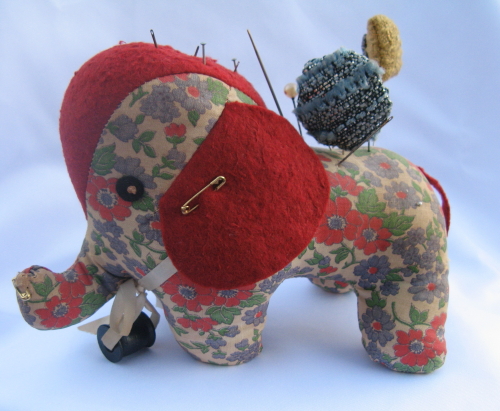
The Elephant Pin Cushion pictured here was made in the early 1940’s.  The exact same pattern was use through the 1930’s.  The ears were made of felt as was the tail and in this case the centerpiece that covered his forehead.   Again this pin cushion was stuffed by hand with cotton through an opening in its belly, which was sewn closed after the stuffing operation.

The eyes were sewn on by making a French knot as the center of the eye, inserting the needle through a Black felt circle for the eye and sewing through the elephant’s head and coming out where the second eye should be, adding the second Black felt eye, adding another French knot for the second eye, and then inserting the needle, make a few blind stitches and then cutting off the thread.

The final work on the Elephant was tying a ribbon around its neck and tying a bow on the back of its head.  When tying the ribbon a tiny spool of thread is tied into the neck ribbon, more to make the animal more attractive than for practical use.  Finally 5 brass safety pins are pinned on the Elephant to complete its decoration.

Sad to say there were no name tags saying made by Mary Meyer.  The only people who recognize these animals are few and far between.  Hopefully a few animal pin cushions may surface, if enough people read this blog.


Share This Post:


November 03 2010

Mary Meyer Pin Cushion Doll – Made in 1938

by Walter Meyer

My name is Walter Meyer and Mary Meyer was my Mother and I grew up in the stuffed toy business.  Today Mary Meyer stuffed toys is located in Townshend, VT, where  I live also.

Mary Meyer’s business began in New York City in 1933.  In those days we were at 3 West 29th Street, on one of the upper floors, which was just off Fifth Ave.  behind the Marble Collegiate Church.  

In 1937 the family and business the moved to Cranford, NJ and in 1945 we moved to Vermont, where we are today.  My Dad, Hans Meyer, had stomach ulcers from the stress of business and wanted to live a quieter, lower stress life.

In the late 1930’s Mary Meyer was designing, manufacturing and distributing their line of animal pin cushions and oil cloth covered stuffed toys and selling them to major department stores like Marshall Field in Chicago and JL Hudson in Detroit and chain stores like Woolworths, Kresge and WT Grants.

In the 1930’s and early 1940’s Dad, being the company’s salesman, would travel all over the eastern USA as far west as the Mississippi River by train calling on his customers.  I still have the accounting journals that show all the customers, shipments and the amount they bought in 1935, 1936, 1937, etc. – up to 1944.

Being based in the New York City area at the time, he also visited the buying offices of the chain stores.  At that time buying offices were places where manufacturers and salesmen could show their products to representatives of the department stores, who then pass their advice on to the head buyer and to the stores.

In the late 1930’s Mary Meyer’s main products were animal pin cushions.  The assortment of pin cushions we made included a Scotty, a Cat, an Elephant, a Duck, a Lamb, a Horse and later a Camel.  Mary Meyer also made a doll pin cushion, which was not as popular, but we have bought 3 of them during the past 5 years on the internet.  I believe the Pin Cushion Dolls were made in the late 1930’s – about 1938.

In 2007 my daughter Linda found one on the internet and purchased it for our Mary Meyer museum.  It was from Kansas.  About 6 months later she found a second one, which she purchased for her own collection.  A friend found a third one for her Mary Meyer collection.  The dolls were not as popular as the animal pin cushions.  I do not believe we manufactured more than a few thousand pieces but 70 years later we have found 3 dolls.  Possibly there may be more out there.

I know the dolls are ours because I remember them as a youngster.  They also have a Gold foil string tag on them that says “Mary Meyer – Pin Cushion – Hand Made”.  The photo of the pin cushion doll we have is shown here along with an enlargement of the Mary Meyer Gold foil hang tag.

 The silk-screened faces came from Crescent Hill Novelty Co. in New York City, a supplier we used for many, many years.  Mother and Dad used them in the 1930’s and 40′s and I used them in Vermont from the 1950’s until the early 1980’s.  They supplied doll and monkey faces and other toy parts to the toy manufacturing trade.

The body was made from colorful cotton percale  and the body parts were cut with an up-and-down knife cutting machine or a cutting machine with a circular blade.  The garment industry used these same cutting machines to cut out all types of clothing.  The sewing was done on a commercial sewing machine and sewn wrong side out.  The toy is sewn wrong-side-out, so the seams won’t show after the toy is turned right-side-out.   An opening for turning and stuffing is left in the back of the toy in an inconspicuous place.

The stuffing was the next operation and done by hand.  The cotton used was usually garneted cotton, which made from cotton fabric scraps left over from the weaving or manufacturing trades.  These scraps and pieces are accumulated and purchased by a company, who shreds pieces of fabric. This brings the cotton back to its original, fluffy condition, as though it had been just picked from the cotton plant.

The opening is located in the upper back of the toy.  The cotton is stuffed into the toy, filling first the lower legs, then the body, then the arms, the head and finally the chest.  The opening is then sewn closed by hand.  A ribbon is tied around its neck and tied in an attractive bow.

Being a pin cushion there are usually 5 brass safety pins attached.  In this case the Gold foil tag and the felt cap are attached with two of the safety pins.  Besides the safety pins a small spool of thread is ually attached to the neck-ribbon as a further indication it is for buyers who sew.

The doll pin cushion are then ready to be shipped to the stores that were Mary Meyer customers for resale to women who were making their own cloths and needed a place to store their pins and needles.


Share This Post: